Why Your Compressor Needs a Variable Frequency Drive
An air compressor is one of the largest electricity consumers in any industrial facility. According to the International Energy Agency, pneumatic systems account for 20 to 35% of a plant's total electricity consumption. Yet actual demand for compressed air is rarely constant: it fluctuates throughout shifts, depends on equipment utilisation, and varies by season. This is where a variable frequency drive (VFD, also known as a frequency converter or adjustable speed drive) delivers the greatest impact — it matches the compressor motor speed to actual demand instead of running at full RPM all the time.
In this article, we will examine why traditional valve-based control wastes energy, how a VFD solves this problem, provide concrete savings calculations, and offer practical guidance on selecting and configuring a VFD for screw and reciprocating compressors.
Comparing Compressor Capacity Control Methods
Before diving into the advantages of variable frequency control, it is worth understanding how alternative methods work. The table below highlights the differences between the main approaches.
| Parameter | Load/Unload | Inlet Throttling | Variable Frequency Drive (VFD) |
|---|---|---|---|
| Principle | Compressor runs at full speed; when upper pressure threshold is reached, it switches to idle mode | Inlet valve restricts airflow while motor continues running at full speed | VFD varies motor speed, matching output to actual demand |
| Idle energy consumption | 25-65% of rated power | Reduced but unevenly (50-85% at 50% load) | Proportional to load: 50% air demand means roughly 30% energy |
| Pressure stability | Fluctuations of 0.5-1.5 bar between on/off thresholds | Fluctuations of 0.3-0.8 bar | Stable pressure within 0.1-0.2 bar |
| Starting currents | 6-8x rated current at every motor start | 6-8x rated current at initial start (then runs continuously) | Soft start with no current spikes, begins from 0 Hz |
| Mechanical wear | High: frequent start/stop cycles, coupling shocks | Moderate: continuous operation but at full speed | Minimal: smooth speed changes, reduced vibration |
| Payback period | Standard solution, included in compressor cost | Standard solution | Typically 1-3 years at loads below 80% |
As the comparison shows, under variable load conditions (which describes most real-world plants), VFD control wins across every key parameter.
The Physics of Savings: Affinity Laws for Compressors
For positive displacement (screw and reciprocating) compressors, the relationship between rotational speed and power consumption is described by the approximate formula:
P2 / P1 = (n2 / n1)^k
where k for screw compressors is in the range of 1.3-1.5 (unlike fans and pumps, where k is approximately 3). This means that reducing speed by 20% cuts consumption by 25-30%, and a 40% speed reduction yields savings of up to 50%.
As an example, consider a 37 kW screw compressor running 6,000 hours per year at an average load of 65%:
- Without VFD (load/unload): the compressor consumes 25% of rated power at idle. Average consumption: 37 x (0.65 + 0.35 x 0.25) = 27.3 kW. Annual: 27.3 x 6,000 = 163,800 kWh.
- With VFD: power scales with exponent k of approximately 1.4. Average consumption: 37 x 0.65^1.4 = 20.2 kW. Annual: 20.2 x 6,000 = 121,200 kWh.
- Savings: 163,800 - 121,200 = 42,600 kWh. At a rate of EUR 0.15/kWh, that is EUR 6,390 per year.
If a variable frequency drive for a 37 kW motor costs EUR 1,500-2,500, the payback period is just 3 to 5 months — not years, but months.
How a VFD Controls a Compressor: The Working Algorithm
A typical VFD-based compressor control system works according to the following algorithm:
- Pressure sensor (usually 4-20 mA or 0-10 V) measures pressure in the receiver or main line.
- Built-in PID controller of the VFD compares the measured pressure with the setpoint.
- If pressure is below setpoint, the VFD increases frequency (speed); if above, it decreases.
- When minimum allowable frequency is reached (typically 25-30 Hz for screw compressors) and pressure continues to rise, the VFD can stop the motor, entering sleep mode.
- When pressure drops below the wake-up threshold, the drive smoothly restarts the compressor.
This algorithm is fully automatic: the operator simply sets the desired pressure (e.g. 7.5 bar), and the system maintains it within 0.1-0.2 bar accuracy.
Screw Compressors and VFDs: The Details Nobody Mentions
The screw (rotary) compressor is the most common industrial type. Retrofitting one with a VFD involves several subtleties:
Minimum Operating Frequency
The screw element requires a minimum oil flow for lubrication and cooling. At excessively low speeds, oil delivery becomes insufficient. The typical minimum is 25-30 Hz (50-60% of rated speed). Some manufacturers allow 20 Hz, but no lower.
Cooling System
If the oil cooler fan is mounted on the same shaft as the screw element, cooling deteriorates at reduced speeds. The solution is either a separate fan drive or a minimum frequency limit.
Oil Separator
At reduced speeds, pressure in the oil separator drops, and the differential across the separator may be insufficient for proper oil-air separation. Manufacturers typically recommend not reducing discharge pressure below 4-5 bar.
Unloading Valve
When retrofitting an existing compressor, the standard load/unload valve is typically locked out or configured to function only as an emergency device. Control passes entirely to the VFD.
Reciprocating Compressors: Limitations and Recommendations
Variable frequency control of reciprocating compressors carries more limitations compared to screw types:
- Narrow frequency range: reciprocating compressors typically operate between 35-50 Hz (70-100% of rated speed). Below 35 Hz, lubrication and valve problems emerge.
- Resonance frequencies: the reciprocating motion of the piston generates vibrations. At certain speeds, these can coincide with the natural frequency of the structure. Skip frequencies must be programmed into the VFD.
- Torque pulsations: the VFD must be rated for pulsating loads. Typically, a drive one frame size above the motor rating is selected.
For reciprocating compressors, it is often more cost-effective to use a soft starter instead of a full VFD, if the primary goal is to eliminate starting currents and the need for capacity regulation is minimal.
Selecting a VFD for Compressor Applications
When choosing a variable frequency drive, consider the following criteria:
Power and Current Rating
A VFD is selected based on the motor's rated current, not its power rating. For compressor duty, a 10-15% current margin is recommended, since the resistive torque during a pressurised start is higher than in standard applications.
Load Duty Rating
For screw compressors, a standard (Normal Duty) rating is sufficient. For reciprocating compressors, choose a Heavy Duty (HD) rating with enhanced overload capability (150-180% for 60 seconds).
Built-in PID Controller
Most modern variable frequency drives feature built-in PID controllers that allow the pressure sensor to be connected directly to the VFD, controlling the compressor without an additional external controller.
Ingress Protection (IP) Rating
Compressor rooms often have elevated dust and moisture levels. Choose a VFD with IP54 or higher, or install an IP20 model inside an enclosed cabinet with forced ventilation.
EMC Filter
In industrial environments, a built-in EMC filter (category C2 or C3) reduces electromagnetic interference, which is especially important when sensitive equipment — sensors, scales, or communication systems — operates nearby.
Recommended VFD Series for Compressor Applications
Based on our integration experience, the following series are well-suited for compressor applications:
- ABB ACS580 — wide power range, built-in PID, direct torque control. The ACS880 series is recommended for complex multi-compressor systems.
- Danfoss VLT FC302 — efficient PID controller, built-in harmonic filter, energy monitoring function.
- Siemens SINAMICS G120 — modular design, powerful software, seamless integration with Siemens automation.
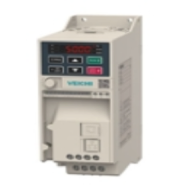
- Veichi AC310 — excellent price-to-performance ratio with a dedicated compressor application macro. For setup details, see our VFD compressor configuration guide.
- Delta Electronics VFD-C2000 — vector control, built-in braking transistor, high protection rating.
VFD-to-Compressor Wiring Diagram
A typical wiring scheme includes the following components:
- Circuit breaker (motor-rated, type B or C recommended) at the VFD input. Rating matches the drive's input current.
- Line reactor or choke (3-5% impedance) — reduces harmonics in the supply network and protects against transient voltage spikes.
- Variable frequency drive — the power stage. The cable between VFD and motor should be shielded, no longer than 50-100 m (model-dependent).
- Compressor motor — shielded cable grounded at both ends.
- Pressure sensor (4-20 mA) — connected to the VFD analogue input for PID feedback.
- External signals: compressor fault, oil overheat, filter blockage — connected to VFD digital inputs for emergency shutdown.
Key VFD Parameter Settings for Compressor Control
After installation, the main parameters must be configured. Below are typical values for a screw compressor:
| Parameter | Recommended Value | Explanation |
|---|---|---|
| Minimum frequency | 25-30 Hz | Below this threshold, screw element lubrication becomes inadequate |
| Maximum frequency | 50 Hz (or 60 Hz if manufacturer allows) | Exceeding this may damage bearings |
| Acceleration time | 10-20 s | Smooth ramp-up prevents hydraulic shocks in the oil system |
| Deceleration time | 15-30 s | Gradual stop allows oil to drain from the screw element |
| PID setpoint | Target pressure (e.g. 7.5 bar / 50% of 0-15 bar sensor signal) | The pressure the system will maintain |
| PID proportional gain (Kp) | 2-5 | Starting value; fine-tune experimentally |
| PID integral time (Ti) | 5-15 s | Too low causes oscillation; too high slows response |
| Sleep mode: frequency | 25 Hz | If pressure rises at minimum frequency, motor stops |
| Wake-up: hysteresis | 0.3-0.5 bar below setpoint | Compressor restarts when pressure drops by this amount |
For step-by-step instructions on configuring specific VFD series, refer to our practical VFD compressor setup guide.
Multi-Compressor Systems: Cascade Control
In larger plants, multiple compressors typically operate together. The optimal strategy is one or two VFD-equipped compressors with the rest running at fixed speed (or with soft starters):
- Base load: fixed-speed compressors run at full capacity (their most efficient operating point).
- Peak load: the VFD compressor adjusts its output, covering the gap between base capacity and actual demand.
- Cascade controller: an external PLC or built-in VFD function switches base-load compressors on and off depending on the load level.
This approach maximises energy efficiency: base compressors operate at peak efficiency while the VFD compressor absorbs all load variability.
Common Mistakes When Installing a VFD on a Compressor
Over the years, we have compiled the most frequent mistakes encountered during compressor retrofits:
- Minimum frequency set too low. Setting 15-20 Hz for a screw compressor causes overheating due to insufficient oil flow. The minimum should be 25 Hz unless the manufacturer specifies otherwise.
- Missing line reactor. Without a reactor, the VFD injects significant harmonics into the supply, which can cause nuisance tripping of protective devices and transformer overheating.
- Acceleration time too short. A rapid start under pressure creates peak torques that overload the coupling and compressor bearings.
- Ignoring resonance frequencies. Without skip frequencies, vibrations can become destructive. Always programme forbidden zones in the VFD parameters.
- Improper cable shield grounding. The shield must be grounded at both ends (at the VFD and at the motor) through proper EMC cable glands, not simply twisted and bolted on.
- Sizing the VFD by power instead of current. A 30 kW motor can have different rated currents depending on voltage and efficiency. Always check the motor nameplate.
Building the Business Case: How to Convince Management
If you are an engineer looking to justify a VFD investment to management, here is a step-by-step methodology:
- Measure actual load: install a data logger on the compressor energy meter for 1-2 weeks. Record consumption during working and non-working hours.
- Determine the average load factor: the ratio of actual air consumption to maximum compressor output.
- Calculate current costs: annual consumption (kWh) x electricity rate.
- Estimate consumption with VFD: use the formula P2 = P1 x (load)^1.4 for screw compressors.
- Determine payback: (VFD cost + installation) / annual savings.
For most plants where the average compressor load is below 75%, the payback period does not exceed 1-2 years. At loads below 60%, it is often less than 6 months.
VFD and Compressor Maintenance
A variable frequency drive does not only save electricity — it also extends compressor service life:
- Bearings: reduced starting loads extend motor and airend bearing life by up to 2x.
- Belts and couplings: eliminating start-up jolts reduces drive train wear.
- Oil: stable operating temperature (due to elimination of idle mode) improves oil viscosity characteristics, extending the change interval.
- Air filter: at reduced output, less air passes through the filter, slowing contamination.
- Oil separator: stable pressure promotes better oil-air separation.
Based on our experience, VFD-equipped compressors require scheduled maintenance 15-25% less frequently than comparable machines with valve-based control.
General VFD Operating Principles
If you are new to variable frequency drives, we recommend reading our overview article on VFD operating principles, which covers basic theory, control types (V/f, vector, DTC), and criteria for selecting a VFD by power rating and load type.
Conclusions
Installing a variable frequency drive on an air compressor is one of the most effective investments in production energy efficiency. Under typical variable load conditions, energy savings range from 25 to 50%, with payback periods from a few months to two years. Beyond direct savings, a VFD provides stable pneumatic system pressure, extends equipment life, and reduces maintenance costs.
The key to a successful retrofit is selecting the drive by current (not power), respecting the minimum frequency for the specific compressor type, and properly tuning the PID controller. If you need help with selection or configuration — browse our VFD catalogue or contact our engineers.