Networked robotics and manufacturing innovations: from standalone machines to intelligent ecosystems
Just ten years ago, an industrial robot was an isolated unit performing a pre-programmed sequence of movements with no awareness of the machine next to it. Today the picture is fundamentally different. Robots connect into networks, share data through cloud platforms, learn from each other and coordinate actions across an entire factory floor. This transformation is already reshaping the rules for equipment manufacturers, system integrators and end users of industrial automation.
Comparing approaches: isolated automation vs. networked robotics
| Parameter | Isolated automation | Networked robotics |
|---|---|---|
| Inter-robot communication | Absent or via central controller | Direct data exchange (peer-to-peer, cloud) |
| Scalability | Adding individual stations manually | Dynamic connection of new nodes |
| Adaptation to changes | Reprogramming each robot | Centralized updates or self-learning |
| Diagnostics | Local, on operator panel | Remote monitoring, predictive maintenance |
| Downtime during failures | Line stops until repair | Automatic task redistribution among robots |
| Total cost of ownership | Lower entry threshold | Lower TCO over 3-5 years |
| ERP/MES integration | Limited, through gateways | Native, through industrial protocols |
Cloud robotics: when computing extends beyond the controller
The concept of Cloud Robotics assumes that a significant portion of computation — image recognition, trajectory planning, production schedule optimization — takes place not on the robot itself but in a cloud data center or on an edge server. The robot remains compact, energy-efficient and relatively inexpensive while gaining computational power unattainable for an embedded controller.
Analysts forecast that by 2025, 75% of industrial data will be processed at the network edge (edge computing), providing robots with faster environmental perception and lower response latency. Edge computing is especially critical where milliseconds matter — in welding, high-speed packaging and precision assembly of electronic components.
A practical example is NVIDIA Isaac Sim, a platform that lets developers test robotic solutions in a virtual environment before real-world deployment. This reduces physical testing costs and accelerates the development cycle. For industrial enterprises, it means the ability to "try on" a new robotic line before the first robot appears on the shop floor.
Multi-robot systems and fleet management
Coordinating dozens or hundreds of robots in a single facility is a challenge that cannot be solved by simply scaling up single-robot solutions. Fleet management systems step in to distribute tasks, prevent route conflicts and optimize the workload of every robot.
A key technology is ROS 2 (Robot Operating System 2) — an open-source platform built specifically for industrial multi-robot environments. ROS 2 provides real-time data exchange, interoperability between robots from different manufacturers and the deterministic behavior required in manufacturing. The RMF (Robot Middleware Framework) add-on further allows heterogeneous robot fleets to share resources — corridors, elevators, workstations — without conflicts.
A notable example is Amazon DeepFleet, which uses generative AI to optimize routes for autonomous mobile robots (AMRs). The result is a 10% reduction in congestion and improved logistics efficiency. The AMR market is projected to reach USD 9.26 billion by 2030, growing at a 15.6% CAGR.
The role of VFDs and servo drives in networked robotics
Networked robotics places new demands on power electronics. Variable frequency drives within robotic lines must not only control motor speed but also integrate into the facility-wide network infrastructure. Modern VFDs support industrial protocols such as EtherCAT, PROFINET and EtherNet/IP, enabling programmable logic controllers to coordinate dozens of drives simultaneously.
Servo drives in robotics are responsible for positioning accuracy and motion dynamics. In a networked architecture, the servo controller receives commands from the central management system and transmits telemetry — winding temperature, vibration levels, cycle counts — back to the cloud for analysis. This is the foundation of predictive maintenance: the system warns about bearing replacement or calibration needs weeks before failure.
For manufacturers using expansion boards for frequency inverters, networked architecture opens new possibilities: centralized parameter updates across all drives, torque synchronization between coordinated axes and diagnostic data collection from every drive into a unified monitoring dashboard.
Digital twins in robotic manufacturing
A digital twin is a virtual copy of a physical system that updates in real time based on sensor data. In robotics, a digital twin allows operators to model robot behavior, test new programs and predict wear on mechanical components without stopping actual equipment.
In February 2025, KUKA entered a strategic partnership with Dassault Systemes, integrating its mosaixx platform with the 3DEXPERIENCE environment to create digital twins of robotic systems. FANUC and Foxconn Fii became among the first robot manufacturers to support 3D, OpenUSD-based digital twins — manufacturers can simply drag and drop equipment into a virtual environment for design and simulation.
For the factories of the future, digital twins are becoming a necessity rather than an option. They shorten time-to-market for new products, reduce commissioning errors and optimize the energy consumption of each robot. The market for robot digital twin chips is estimated to exceed USD 500 million by 2026.
Cobots and the Internet of Cobots (IoC)
Collaborative robots — cobots — are designed for safe operation alongside humans without protective fencing. The cobot market is growing from USD 2.15 billion in 2024 to a projected USD 11.64 billion by 2030. The real breakthrough, however, is the Internet of Cobots (IoC) concept, where collaborative robots form a network, dynamically distribute tasks and adapt to changes in the production process.
IoC involves connecting cobots via 5G networks, which provide ultra-low data transmission latency and reliable connectivity even in challenging industrial environments. A cobot that assembles a part at one station transmits quality information to the next cobot in the chain, which then adapts its movements accordingly. This level of coordination is unachievable with isolated machines.
Five global robotics trends for 2026
The International Federation of Robotics (IFR) has identified five key trends shaping the industry in 2026:
- AI and autonomy. Analytical AI detects patterns for predictive maintenance, generative AI allows robots to learn new tasks independently, and agentic AI combines both approaches for autonomous operation in complex real-world conditions.
- IT-OT convergence. Real-time data exchange, automation and advanced analytics form the foundation of Industry 4.0, creating seamless connections between digital and physical systems.
- Humanoid robots. The transition from prototypes to real-world deployment in warehouses and manufacturing, where they must meet industrial standards for cycle times, energy consumption and maintenance costs.
- Safety and cybersecurity. Growing autonomy complicates the safety landscape — robot controllers and cloud platforms become targets for cyberattacks. Clear ISO standards and liability frameworks are needed.
- Robots as a workforce solution. Automating routine operations compensates for labor shortages while upskilling programs help workers adapt to new realities.
Practical cases: from Komatsu to lights-out factories
Japanese heavy equipment manufacturer Komatsu connected all major production processes to the Internet back in 2011, allowing managers to monitor operations in real time across all countries. Their autonomous haul trucks, operating at the Rio Tinto mine in Australia, became one of the first large-scale examples of networked robotics in heavy industry. The Joy Global continuous miner (acquired by Komatsu) wirelessly transmits up to 7,000 parameters per second to a data processing center.
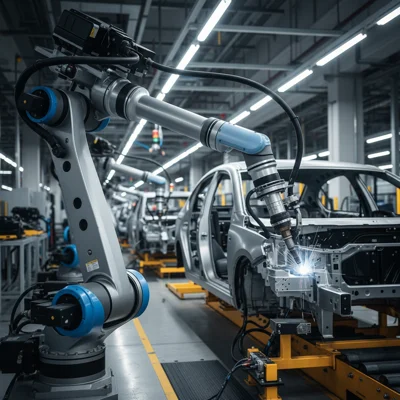
German company KUKA built a factory for Jeep that produces one car body every 77 seconds, using hundreds of robots connected to a closed cloud environment. In October 2025, SoftBank Group announced the acquisition of ABB's robotics division for USD 5.4 billion — a testament to the strategic importance of collaborative and intelligent robotic systems.
The concept of lights-out manufacturing — factories running around the clock without human presence — is becoming reality in 2026. Investment in robotics reached USD 7.3 billion in the first half of 2025 alone, and global industrial robot sales totaled USD 16.7 billion.
Swarm robotics and decentralized control
Swarm robotics is an approach where a large number of relatively simple robots perform complex tasks through decentralized coordination. Unlike centralized architecture where a single controller manages all machines, a swarm has no single point of failure. If one robot breaks down, the others automatically redistribute its tasks.
The US Pentagon allocated USD 500 million to swarm technology development, underscoring the seriousness of this direction. For industrial applications, swarm robotics is especially promising in logistics, pipeline and structural inspection, and agriculture.
Choosing equipment for networked automation
The transition to networked robotics does not happen overnight. For enterprises planning modernization, it is critical to select components with built-in network support:
- Variable frequency drives with EtherCAT, PROFINET or Modbus TCP support — they integrate easily into the plant-wide network and enable remote diagnostics.
- Servo drives with high-resolution feedback — for precise control of robotic manipulator movements.
- PLCs supporting IoT protocols (MQTT, OPC UA) — for connecting the automation layer with cloud analytics platforms.
- Industrial gateways with edge computing capabilities — for local processing of critical data without cloud dependency.
The VEICHI frequency inverter catalog includes models with built-in industrial network support, simplifying integration into networked robotic systems. The right choice of power electronics at the design stage will save months of integration work and ensure reliable operation of the entire system.
Challenges and outlook
Despite impressive progress, networked robotics faces serious challenges. Cybersecurity remains the primary risk — a network-connected robot becomes a potential target. Standardization still lags behind technology: ROSCon 2025 discussed standards SS 713 (data exchange between robots, elevators and automated doors) and TR 130 (interoperability between robots and central control systems), but widespread adoption is a matter of the coming years.
The global robotics market is approaching USD 50 billion in 2025 (an 11% increase over 2024) and is projected to reach USD 111 billion by 2030 at a 14% CAGR. This means that investment in networked automation is not a passing trend but a strategic necessity for manufacturers planning to remain competitive.