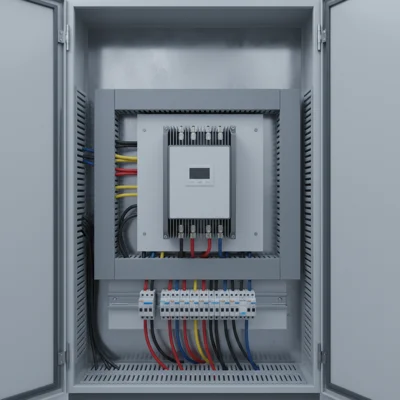
Variable Frequency Drive for Extruder: Why It Matters
Polymer extrusion is a process where screw rotation stability directly determines the quality of the final product. Speed fluctuations of even 2-3% lead to uneven wall thickness in pipes, films, or profiles. A variable frequency drive (VFD) eliminates this problem: it smoothly regulates motor speed from 0.5 Hz to the operating frequency, maintaining the set speed with an accuracy of 0.5%.
The VEICHI AC310 series is engineered for demanding industrial loads. With a power range from 0.75 to 400 kW, it covers everything from laboratory single-screw extruders to industrial granulation lines. On the Ukrainian market, 34 models are available in this series with 220 V (single-phase) and 380 V (three-phase) supply.
Why VEICHI AC310 Is the Right Fit for Extrusion Equipment
Sensorless Vector Control
The AC310 implements sensorless vector control (SVC) with a regulation range of 1:200 and a starting torque of 150% at 0.5 Hz. For an extruder, this means confident startup even under the load of cold material in the barrel, without jerks or motor overloads. In encoder mode (FVC), the range extends to 1:1000, and the starting torque increases to 200%.
Built-in PID Controller
In extrusion, temperature control of heating zones is no less critical than screw speed. The AC310 features a built-in PID controller that can manage auxiliary loops -- cooling zone ventilation, melt pressure, or temperature via an external feedback sensor (analog input 0-10V or 4-20mA). This allows building a closed-loop control system without an additional PLC.
Motor and Equipment Protection
Extruders run continuously, often 24/7. The VEICHI AC310 provides comprehensive protection: output short-circuit, motor overload, overvoltage and undervoltage, heatsink overtemperature, and phase loss. The automatic restart function after power failure (details on AC310 auto-restart) minimizes downtime -- the drive resumes operation according to a programmed algorithm within 0.5-30 seconds.
Industrial Communications
Standard Modbus RTU (RS-485) is included. Optional modules for PROFIBUS-DP, CANopen, and PROFINET enable integration into any automation system. For small lines without a PLC, an HMI panel can be connected directly to the drive.
AC310 Power Selection for Typical Extruders
Proper VFD power selection depends on screw diameter, polymer type, and line throughput. Below are recommendations for the most common configurations:
| Extruder Type | Screw Diameter, mm | Motor Power, kW | Recommended AC310 Model | Rated Current, A |
|---|---|---|---|---|
| Laboratory single-screw | 20-30 | 1.5-4 | AC310-T3-1R5G/2R2P-B ... AC310-T3-004G/5R5P-B | 4-10 |
| Film (blown film) | 45-65 | 11-22 | AC310-T3-011G/015P-B ... AC310-T3-022G/030P-B | 25-45 |
| Pipe PE/PP | 60-90 | 30-55 | AC310-T3-030G/037P ... AC310-T3-055G/075P | 60-110 |
| Profile (PVC window) | 65-80 | 37-75 | AC310-T3-037G/045P ... AC310-T3-075G/090P | 75-150 |
| Twin-screw (compounding) | 50-95 | 55-160 | AC310-T3-055G/075P ... AC310-T3-160G/185P-L | 110-310 |
| Industrial pelletizer | 100-150 | 132-400 | AC310-T3-132G/160P-L ... AC310-T3-400G/450P-L | 250-750 |
General rule: select a drive one power step above the motor nameplate rating (the G/P designation in the SKU -- G for heavy-duty load, P for pump/fan duty). For extruders, always use the G (heavy-duty) rating.
Energy Savings: Real Numbers
The traditional extruder drive scheme involves an induction motor + mechanical gearbox + throttle or rheostat speed control. Replacing this with VFD control via VEICHI AC310 delivers the following results:
- 20-35% electricity savings -- the greatest effect occurs at reduced speeds (40-70% of rated), where the quadratic relationship between power and speed yields a dramatic reduction in consumption.
- Reduced mechanical wear -- soft starting (instead of direct-on-line starting with peak current of 6-8x rated) extends the service life of screw bearings, couplings, and gearboxes by 40-60%.
- Noise reduction of 15-30 dB -- particularly noticeable on lines above 30 kW, where the mechanical gearbox is the primary noise source.
- Lower reactive power -- the power factor at the AC310 output is 0.97-0.99 (versus 0.7-0.85 for uncontrolled motors), reducing the load on the transformer substation.
Example: on a pipe line with a 37 kW motor operating at an average 65% load for 5,000 hours/year, annual savings amount to approximately 28,000 kWh. At a rate of UAH 3.2/kWh, that is about UAH 89,600/year -- the AC310-T3-037G/045P drive pays for itself in 10-12 months.
AC310 Setup for Extrusion Drive Applications
Basic VEICHI AC310 configuration for extruder operation involves several key steps. A detailed commissioning guide can be found in the article on VEICHI VFD setup for industrial equipment; here we cover extrusion-specific parameters.
Control Mode
For most extruders, the optimal mode is sensorless vector control (parameter P00.01 = 0 for induction motor). Before starting, perform motor auto-tuning (P00.16 = 1 for static or P00.16 = 2 for dynamic) so the drive measures winding parameters and builds an accurate motor model.
Acceleration and Deceleration Time
Extruder screws have significant rotational inertia. Recommended acceleration time (P00.11): 30-60 seconds for screws up to 65 mm diameter, 60-120 seconds for screws 90 mm and above. Too-fast acceleration can trigger overcurrent faults, while too-slow acceleration risks winding overheating at low frequencies.
S-curve Acceleration
Enable S-curve acceleration/deceleration (P00.15 and P00.16) for smooth speed ramp-up and ramp-down. This reduces mechanical shock in gear trains and extends the service life of the screw assembly.
Frequency Limits
Set the upper frequency limit (P00.04) according to the maximum permissible screw speed. For most single-screw extruders, this is 50-60 Hz; for twin-screw units, 35-50 Hz. Set the lower limit (P00.05) to 5-8 Hz to prevent motor overheating at minimum speed.
VEICHI AC310 vs. Soft Starter: Which to Choose
A soft starter provides only smooth starting and stopping of the motor but does not regulate speed during operation. For extruders where screw speed must change based on the formulation, product thickness, or line throughput, a VFD is the only viable solution. A detailed comparison of VFDs and soft starters can be found in the article Top questions about VFDs and soft starters.
| Parameter | Soft Starter | VEICHI AC310 |
|---|---|---|
| Speed regulation | No (start/stop only) | Yes, 0.5-600 Hz |
| Speed accuracy | Not applicable | 0.5% (SVC) / 0.02% (FVC) |
| Starting torque at 0.5 Hz | Not applicable | 150% (SVC) / 200% (FVC) |
| Energy savings at partial load | Minimal (1-3%) | Significant (20-35%) |
| Built-in PID controller | No | Yes |
| Industrial bus | Rarely | Modbus RTU, PROFIBUS, CANopen, PROFINET |
| Auto-restart after failure | Limited | Full (programmable) |
| Cost (for 37 kW) | ~UAH 25,000 | ~UAH 78,680 |
A soft starter is practical only for auxiliary drives -- such as a cooling pump or blower fan where speed does not vary.
Implementation Experience: AC310 Series in Industry
Beyond extrusion, VEICHI AC310 variable frequency drives operate successfully on other industrial equipment. Experience in chemical production applications is covered in the article VEICHI AC310 in chemical manufacturing. Specifications for the base VEICHI series are available in the VEICHI AC10 frequency converter overview. These materials provide deeper insight into the VEICHI platform capabilities for various automation tasks.
AC310 Model Range for Extrusion Lines (3x380 V)
| Model | Power, kW | Rated Current, A | Max Frequency, Hz |
|---|---|---|---|
| AC310-T3-004G/5R5P-B | 4.0 | 10 | 600 |
| AC310-T3-011G/015P-B | 11.0 | 25 | 600 |
| AC310-T3-022G/030P-B | 22.0 | 45 | 600 |
| AC310-T3-037G/045P | 37.0 | 75 | 600 |
| AC310-T3-055G/075P | 55.0 | 110 | 600 |
| AC310-T3-075G/090P | 75.0 | 150 | 600 |
| AC310-T3-110G/132P | 110.0 | 210 | 600 |
| AC310-T3-160G/185P-L | 160.0 | 310 | 600 |
| AC310-T3-250G/280P-L | 250.0 | 470 | 600 |
| AC310-T3-400G/450P-L | 400.0 | 750 | 600 |